
How to add an AI voiceover in Tella
You recorded a clean walkthrough in Tella, but you would rather not narrate it with your own voice on the take - the room is noisy, you keep stumbling on a word, or you want to write the script once and have it read back perfectly every time you revise the video. So you go looking for an AI voiceover option in the editor.
It is a reasonable thing to want. Here is the straight answer on where Tella stands today, the manual workaround that gets you partway there, and how to do it end to end in one app if you would rather not juggle tools.
Does Tella have AI voiceover?
No. As of May 2026, Tella does not generate narration from a script. It records and edits the audio you give it - microphone, system audio, imported music - but there is no text-to-speech engine inside the app.
Tella does not run a public feature-request board (no Canny, Featurebase, or open roadmap), so there are no upvotes to point at - but the absence is clear from Tella’s own properties. AI voiceover and text-to-speech appear nowhere in Tella’s complete documentation index (tella.com/docs/llms.txt), nowhere in the changelog covering December 2022 through May 2026 (tella.com/docs/changelog), and nowhere on the pricing page’s feature lists (tella.com/pricing). Tella is a well-made product from a strong team that has focused on browser-based recording, clips, and a polished share page rather than on voice generation. That is a defensible product decision - it just means script-based voiceover is not something Tella can do today.
The manual workaround in Tella
You cannot generate a voiceover from text inside Tella, but you can bring one in from outside. The workaround hangs on Tella’s audio import:
- Write your script. Watch your recording and write what you want said at each point. Keep sentences short.
- Generate the audio elsewhere. Paste the script into a standalone text-to-speech tool - ElevenLabs is the most natural-sounding option, with Google Cloud TTS, Amazon Polly, and OpenAI TTS as alternatives. Export the result as an audio file.
- Import it into Tella. Add the generated file through Tella’s audio panel (tella.com/docs/help/editing/add-background-music-to-your-video.md).
- Lower or mute the original audio so the narration is not competing with whatever your microphone picked up while recording.
- Hand-align the timing until the narration lines up with the right moments on screen.
This works for a single pass, but be honest with yourself about the downsides before you commit to it. Tella’s audio import is built for background music, not a narration track - it is one track laid under the video, not speech synced section by section. If you trim or re-order a clip, the imported audio does not move with it, so you re-align by hand. Change one sentence and you go back to the external tool, regenerate, re-export, re-import, and re-align the whole thing. You are also maintaining two tools and two accounts.
To be fair about what Tella does offer for audio: it ships filler-word removal, silence trimming, and Studio Voice, an AI enhancement that cleans up background noise and evens out levels on your recorded microphone audio (tella.com/docs/help/editing/studio-voice-audio-enhancement.md). Those are genuinely useful - but they clean up audio you spoke yourself; they do not generate narration from a script.
How to add an AI voiceover with Tight Studio instead
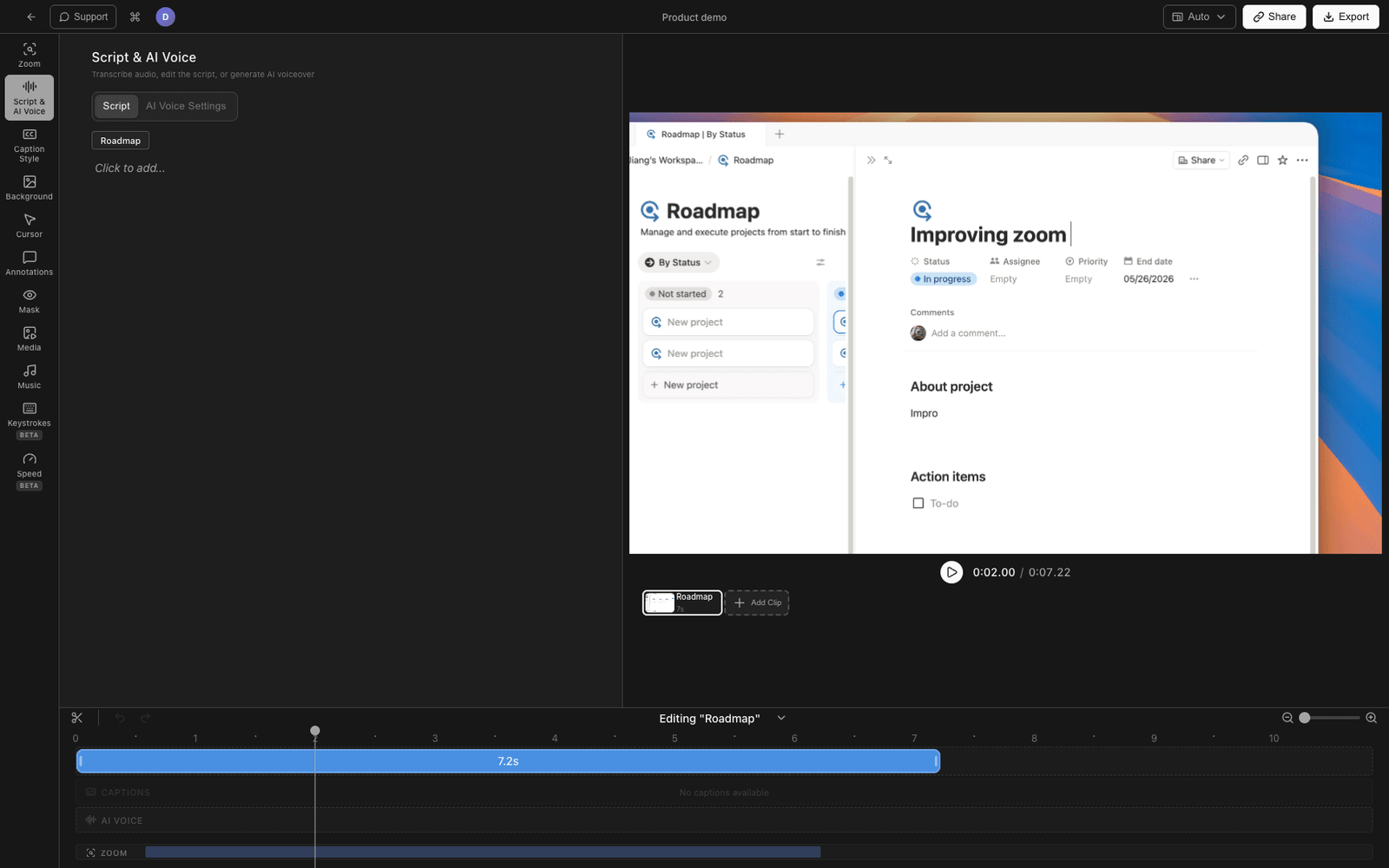
If the script-to-narration loop is the whole point, it helps to have it inside the editor where the video lives. Tight Studio is a Mac screen recorder and editor with AI voiceover built in, powered by ElevenLabs’ latest voice model. The narration is tied to the timeline, so editing the script and editing the video are the same workflow.
Here is the end-to-end flow:
- Record your screen as usual - with or without your microphone. If you do not want to narrate at all, record silent.
- Open the AI Voice panel. Tight Studio can transcribe the audio you did record into an editable script, or you can type the script from scratch.
- Edit the script as text. Fix wording, tighten sentences, and split it into segments that match sections of the recording.
- Pick a voice from the built-in ElevenLabs library and generate. The narration is produced per segment and snapped to the matching part of the timeline automatically - no hand-alignment.
- Tune it. Choose the voice model (ElevenLabs V3 or V2.5), adjust stability and AI-voice volume, preview a segment, change a line, and regenerate just that segment without touching the rest.
- Export with the voiceover baked in.
Because the script is the timeline, re-ordering or trimming a section moves its narration with it, and a one-line script edit is a one-segment regeneration - not a full external round trip.
One extra step worth knowing about: Tight Studio’s Voice Lab lets you record your own voice once and then generate future voiceovers in a clone of it, so you can keep your personal sound while still writing and revising as text - something neither Tella nor the import workaround can do. Tight Studio is the all-in-one screen recorder for tutorials, demos, course videos, and social cuts, so the voiceover sits alongside click-following zoom, cursor animation, annotations, and intro/outro slides rather than being a bolt-on to a bare recording.
Why we built it into the editor
We kept the script and the timeline as one object on purpose. The reason people want AI voiceover is iteration: write, watch, fix a line, watch again. Every tool boundary in that loop - export here, import there, re-align by hand - is friction that makes you iterate less, and the narration ends up worse for it. Generating per segment against the script you already edited removes that boundary.
Tella vs Tight Studio for AI voiceover
| Tella | Manual workaround (TTS tool + Tella) | Tight Studio | |
|---|---|---|---|
| Built-in script-to-voice | No | No - external tool | Yes (ElevenLabs) |
| Per-segment sync to timeline | n/a | Manual alignment | Automatic |
| Regenerate after a script edit | n/a | Full external round trip | One segment, in app |
| Voice cloning | No | Depends on external tool | Yes (Voice Lab) |
| Tools to maintain | One | Two + two accounts | One |
Frequently asked questions
Does Tella have text to speech?
No. As of May 2026, Tella has no text-to-speech or AI voiceover feature. It records and edits microphone, system, and imported audio, but it does not generate narration from a script. Text-to-speech appears nowhere in Tella’s documentation index, changelog, or pricing page.
Can you add a voiceover in Tella?
You can add a voiceover by recording your microphone while you record your screen, or by generating audio in a separate text-to-speech tool and importing it into Tella as an audio track. Tella cannot generate the voiceover itself - the second path needs an external tool plus manual alignment, and Tella’s audio import is built for background music rather than synced narration.
How do I narrate a screen recording without using my own voice?
Write a script and run it through an AI text-to-speech tool to produce the narration. You can do this with a standalone tool (ElevenLabs, Google Cloud TTS, OpenAI TTS) and import the audio into your editor, or use a screen recorder with built-in AI voiceover like Tight Studio, where the script stays linked to the timeline and regenerates per segment.
What is the best Tella alternative for AI voiceover?
If AI voiceover is the main thing you need, Tight Studio is the closest like-for-like alternative on Mac - it has the same category of recording and editor polish as Tella, plus built-in ElevenLabs voiceover and voice cloning that Tella does not offer. For voiceover only (no screen recording), a standalone tool like ElevenLabs also works.
Is Tella’s Studio Voice the same as AI voiceover?
No. Studio Voice is an AI cleanup pass - it removes background noise and evens out the levels on audio you recorded yourself. It does not generate new speech from a script. It improves your real voice; it does not replace the need to speak.