

You finished a tutorial in Screen Studio and wanted to open it with a clean title card - the recording name, your logo, one line of context - then close it with an outro slide. You went looking for a way to add a full-screen text slide before the first clip. You did not find one. You are not missing a setting. Screen Studio cannot add standalone text slides or title cards.
Direct answer: Screen Studio currently limits in-video text to captions and cannot add a standalone intro slide, outro slide, or freeform text overlay. Tight Studio is a screen recorder and video editor for Apple Silicon Macs that adds timed text from the Annotations panel and imports a designed image or video as a separate intro or outro clip.
This guide covers both intents: how to add text in Screen Studio with the options it supports, and how to build a true title card in Tight Studio without stitching the final export in a second editor.
How to add text in Screen Studio today
Screen Studio has exactly one kind of in-video text: captions. It transcribes your voiceover - Whisper or Apple Speech Recognition - and puts the resulting subtitles on screen. You can edit the transcript, resize the captions, and export it. That is the whole text feature.
Captions are derived from what you said. They are not text you place. As of May 2026, Screen Studio’s editor does not offer:
- A standalone full-screen text slide (a card with the recording behind it removed)
- An intro card or outro card before or after your clips
- A blank slide between sections
- Freeform text overlays you position on top of the video yourself
That last one matters: even putting your own text on top of the recording is not a Screen Studio feature - it is a separate open request (“Annotation Tools,” 367 upvotes, Planned). A true title card, where the screen recording is not playing behind the text at all, does not exist in Screen Studio in any form.
The official feature request: “Full text slides” on Screen Studio’s public feedback hub has 434 upvotes and has sat at “Planned” status for over three years - one of the most-upvoted requests on the entire hub and by far the highest-voted text/slide request: hub.screen.studio/p/full-text-slides. Two narrower requests are also open and unshipped - “Title Cards: Add a Title / Text Pages” (hub.screen.studio/p/title-cards-add-a-title-text-pages, In Review) and “Add title page image” (hub.screen.studio/p/add-title-page-image, In Review). Importing an external clip to use as a card does not work either: “Import clips or append external video clips” (hub.screen.studio/p/import-clips-or-append-external-video-clips) has 438 upvotes and is also still “Planned.” The team has acknowledged the demand for years; it has not shipped.
Workarounds in Screen Studio
If you are staying in Screen Studio, here is how people add something resembling a title card today. None of these is a native feature.
Workaround 1: Build the card elsewhere and stitch it in another editor
Make the slide in Keynote, Figma, Canva, or Google Slides, export it as an image or short clip, then concatenate it with your Screen Studio export in iMovie, CapCut, or Premiere.
- Works for: a one-off video where you already have a second editor open
- Does not work for: anyone who picked a single screen recorder to avoid a multi-tool pipeline. Screen Studio cannot import the card back in - it has no clip import - so the title-card stitching always happens after Screen Studio, in a different tool, and any later edit means redoing the round trip.
Workaround 2: Fake a card with a pause and a zoom
Open the recording on a blank desktop or a solid-colored window, hold still for a few seconds, and lean on captions for the title text.
- Works for: almost nothing convincingly
- Does not work for: a real title card. There is no full-screen text layer, no background you control, and the cursor and desktop are still on screen. It reads as dead air, not an intro.
Workaround 3: Add the slide entirely in post
Skip the idea of doing it in Screen Studio at all. Export the recording and treat title cards as a separate step in a general video editor every time.
- Works for: people with an editing habit and time per video
- Does not work for: quick-turnaround tutorials, or keeping the whole job in one app.
The honest summary: there is no setting to find. A title card means leaving Screen Studio for another tool. That extra hop - and not being able to bring the card back into the recorder - is the part Tight Studio handles differently.
How to add an intro or outro slide in Tight Studio
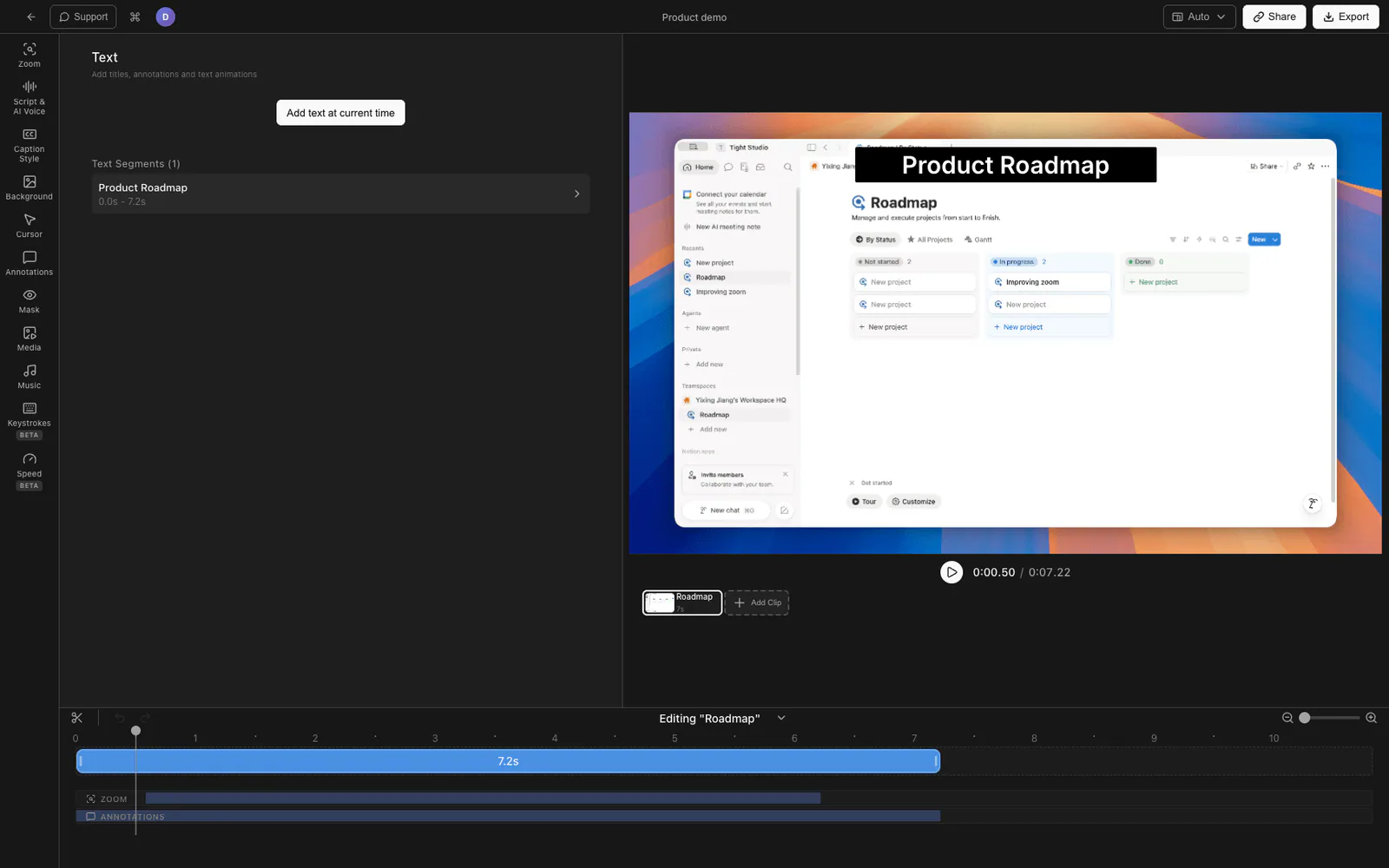
Tight Studio is a screen recorder and video editor for Apple Silicon Macs. It does not currently have a built-in “type your title text here” slide editor. Instead, it supports two shipped workflows: timed text overlays for titles placed over footage, and media import for a standalone image or video that becomes its own intro or outro clip.
Option 1: Design the slide and import it as a clip
This is the path that gives you a real title card today.
- Design the slide in whatever you already use - Keynote, Figma, Canva, Google Slides. Export it at the same dimensions as your recording (e.g. 1920x1080 for a 16:9 video) so it fills the frame edge to edge. PNG or JPG both work.
- In the Tight Studio editor, open Add Clip beside the clip carousel and choose Import media as clip. In the Import a clip window, select the slide from your Mac or media library. Tight Studio accepts images as well as MP4 or MOV files for an animated card.
- The slide appears as its own card in the clip carousel. Drag it to the start for an intro or the end for an outro. An imported image starts at five seconds; adjust its duration on the timeline.
Unlike Screen Studio, the card lives inside the recording project - no separate editor, no post-export concatenation, and you can re-trim or reorder it any time without a round trip.
Option 2: Put a title or lower-third on the recording with a text overlay
If you do not want a separate full-screen card but want a title on the footage - a section label, a name, a “Step 2” marker - Tight Studio has a shipped Annotations text feature.
- Open the Annotations panel and add a text element.
- Set the content, font, size, color, a background box, and position it anywhere on the frame.
- Give it an entrance and exit animation (fade, slide, or scale) so it appears and clears cleanly.
This is text rendered over the recording, not a standalone slide - it covers the lower-third / on-screen-label use case rather than a blank intro card. Screen Studio has no equivalent; freeform text overlays are a separate unshipped request there.
Option 3: Narrate the intro with AI voiceover
A title card lands better with a line of narration over it. Tight Studio can generate an AI voiceover from a script and keep it in sync, so your intro slide can have a clean spoken intro without recording your own audio. (Screen Studio’s text-to-speech request was closed as rejected on its own hub - hub.screen.studio/p/text-to-speach - so this is not coming there.)
Screen Studio vs Tight Studio for text and title cards
| Capability | Screen Studio | Tight Studio |
|---|---|---|
| Standalone full-screen intro/outro slide | No | Yes (import a designed slide as a clip) |
| Import an external image/clip into the recording | No (request Planned, 438 upvotes) | Yes |
| Place a card at the start or end with custom duration | No | Yes |
| Freeform text overlay on the recording (lower-third, label) | No (request Planned, 367 upvotes) | Yes (Annotations, with enter/exit animations) |
| Built-in “type your slide text” editor | No (request Planned 3+ yrs) | Not yet (Slides panel in development) |
| Caption/subtitle text from voiceover | Yes | Yes |
| AI voiceover to narrate the intro | No (request rejected) | Yes |
Why we built it this way
A title card is a design decision - brand, type, color, layout - and people already have the tool they like for that. So rather than ship a thin built-in slide editor first, we made sure you can bring your slide into the recording as a real clip and position it as an intro or outro, with the option to narrate it. A dedicated in-app Slides editor is in development for people who want to skip the design tool entirely; until then, import-a-clip is the honest, working path, and it is one Screen Studio does not offer at all.
Frequently asked questions
Can Screen Studio add a title card or intro slide?
No. As of May 2026, Screen Studio cannot add a standalone text slide, title card, intro card, or outro card. The “Full text slides” request on its feedback hub has 434 upvotes and has been at “Planned” status for over three years without shipping. Screen Studio’s only in-video text is captions generated from your voiceover.
Can I import an image or clip into Screen Studio to use as a title card?
No. Screen Studio has no clip or image import. The “Import clips or append external video clips” request has 438 upvotes and is still “Planned.” Any title card has to be added after export, in a separate video editor.
How do I add an intro slide to a screen recording in Tight Studio?
Design the slide in any tool and export it at your video’s resolution. In Tight Studio, choose Add Clip, select Import media as clip, and pick the image in the Import a clip window. Drag its card to the start of the clip carousel for an intro or to the end for an outro, then set the image duration on its timeline.
Does Tight Studio have a built-in slide editor where I type the title text?
No. Today the working path is to design the slide in your preferred tool and import it as a clip, which Screen Studio cannot do inside an existing project. For text directly on the recording, such as labels and lower-thirds, Tight Studio’s Annotations text feature is available now.
Can I put text on top of the recording instead of a full slide?
Yes, in Tight Studio. The Annotations panel lets you add text with a custom font, size, color, background box, position, and fade/slide/scale animations. Screen Studio does not have user-placed text overlays; that is a separate open request on its hub.